 I-COST

The Tender Trap: Winning the Job vs Protecting the Profit
In the UK commercial contracting sector, winning a competitive tender often triggers immediate celebration. The commercial director reviews an approved bid reflecting a target gross margin of 14% to 18%. Yet, by the six-month mark of project delivery, that margin has frequently eroded to single digits. By final account, many specialist subcontractors discover their actual outturn margin is barely 2% to 3%—or worse, a trading deficit.
This phenomenon, known throughout the industry as margin leakage, rarely stems from catastrophic structural failures or single massive disputes. Instead, it occurs through a compounding series of minor commercial oversights: unpriced scope additions, informal site agreements, supplier price increases accepted without challenge, and labour hours misallocated to base contract work rather than variations.
For specialist subcontractors and main contractors operating with annual turnovers between £500,000 and £15 million, understanding and eliminating these leakage mechanisms is essential for financial resilience.
Five Primary Mechanisms of Margin Leakage
1. Procurement Price Drift
Estimators build tenders using quotes obtained weeks or months before award. Between tender submission, client negotiation, and eventual site order placement, market rates fluctuate. According to Department for Business and Trade (DBT) construction material indices, core commodities such as timber, steel, and insulation experience frequent price adjustments. When buyers place orders against expired quotations without checking the original estimate allowance, the cost difference immediately erodes margin.
2. The Verbal Instruction Vulnerability
On fast-paced UK construction sites, client project managers and main contractor site agents regularly ask subcontractors to carry out minor modifications: adjusting duct runs, adding socket positions, or altering door ironmongery. Eager to maintain collaborative relationships, trade supervisors frequently proceed on verbal requests. Without a written confirmation of oral instruction (CAI) or formal variation order issued in accordance with JCT or NEC4 provisions, the subcontractor assumes 100% of the commercial risk.
3. Uncontrolled Daywork Hours
Dayworks are often regarded as safe, cost-plus work. In practice, unapproved dayworks represent one of the largest margin drains on UK projects. Operatives record hours on paper daywork sheets that sit in site wallets for weeks. When submitted late at month-end valuation, main contractor quantity surveyors frequently reject them due to lack of prior authorisation, missing allocation breakdown, or failure to reference specific instruction numbers.
4. Preliminaries Overrun and Programme Extension
Preliminaries—including site supervision, welfare facilities, craneage, scaffolding hire, and temporary power—are time-dependent costs. If a 20-week programme drifts to 24 weeks due to concurrent delays, weekly preliminary costs continue accruing. Unless the contractor submits timely contractual notices of delay and claims loss and expense under the relevant contract clauses, these additional overheads are funded entirely out of company profit.
5. Lack of Live Committed Cost Visibility
Many contractors track financial progress through retrospective accounting software or spreadsheet CVRs updated weeks after month-end. By the time an accountant notes that material expenditure has exceeded the estimate budget, the goods have been consumed, installed, and covered over. Visibility must exist at the point of ordering, not at the point of invoicing.
Realistic Case Scenario: Commercial Fit-Out Package Variance
To demonstrate how quickly margin dissolves, consider a representative £1,250,000 commercial office fit-out contract in Birmingham undertaken by a specialist interior contractor:
| Commercial Package | Tendered Budget | Outturn Final Cost | Variance (£) | Primary Cause of Leakage |
|---|---|---|---|---|
| Partitions & Ceilings Materials | £340,000 | £361,200 | +£21,200 | Unindexed board price increases and 4% unbudgeted offcut waste |
| Direct & CIS Trade Labour | £410,000 | £442,500 | +£32,500 | Re-sequencing delays; trade gangs held up awaiting M&E first fix |
| Specialist Joinery Subcontract | £185,000 | £194,800 | +£9,800 | Architect detail revisions carried out without formal variation notice |
| Plant Hire & Access | £45,000 | £56,400 | +£11,400 | Scissor lifts retained on site during 3-week programme drift |
| Site Preliminaries & Management | £85,000 | £101,500 | +£16,500 | Additional 4 weeks site presence without agreed extension of time |
| Total Direct Costs | £1,065,000 | £1,156,400 | +£91,400 | Total unrecovered cost overrun |
| Contract Selling Price | £1,250,000 | £1,272,000 | +£22,000 | Only 24% of variation value successfully claimed |
| Net Profit Margin | £185,000 (14.8%) | £115,600 (9.1%) | -£69,400 | 5.7% margin lost to operational leakage |
Step-by-Step Guidance: Protecting Margin from Day One
Step 1: Baseline the Commercial Target
The moment a tender is awarded, convert the estimator's bid model into an operational baseline budget. Strip out speculative allowances and segregate targeted profit. Every package must have an assigned financial ceiling before procurement begins.
Step 2: Implement Mandatory Purchase Orders
Ban informal or phone-based ordering. No supplier delivery should occur without a written Purchase Order (PO) displaying itemised rates, delivery address, project code, and budget allocation. This ensures committed cost is recorded when the commitment is made, rather than when the invoice lands.
Step 3: Enforce Written Variation Confirmations
Train site agents and supervisors to respond to every verbal request with a written confirmation: "We are pleased to carry out this alteration; our commercial team will submit our rate build-up under Clause X for your instruction." Even a basic email sent the same afternoon establishes an audit trail that quantity surveyors can substantiate.
Step 4: Track Committed Costs Weekly
Review committed costs against the budget every Friday. When committed costs reach 80% of any package budget while physical completion is only at 60%, immediate commercial intervention is required before further orders are placed.
Key Takeaways
- Protect Margin from Day One: Margin leakage occurs incrementally; establish committed cost controls before placing orders.
- Enforce Written Protocols: Verbal site requests carry 100% contractor risk. Require written confirmations of verbal instructions (CAIs) immediately.
- Bridge the Estimating-Buying Gap: Ensure the tender estimate baseline directly governs purchase order authorization and live project tracking.
Explore how I-Cost supports construction commercial management
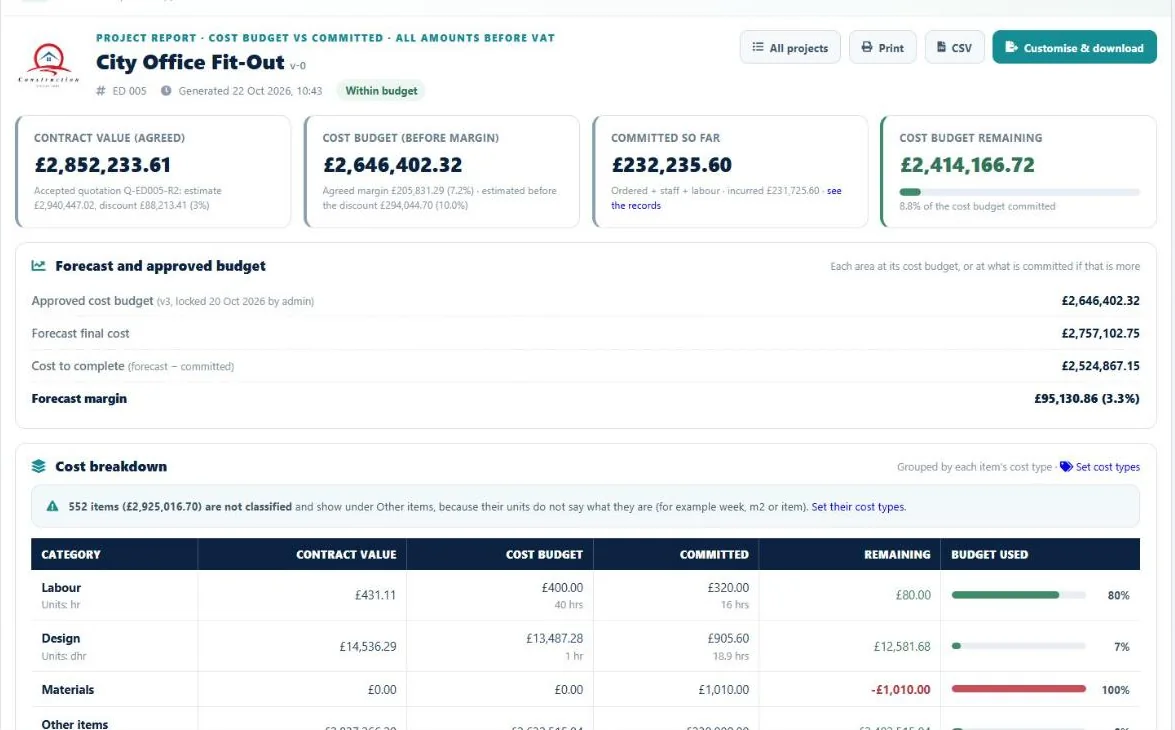
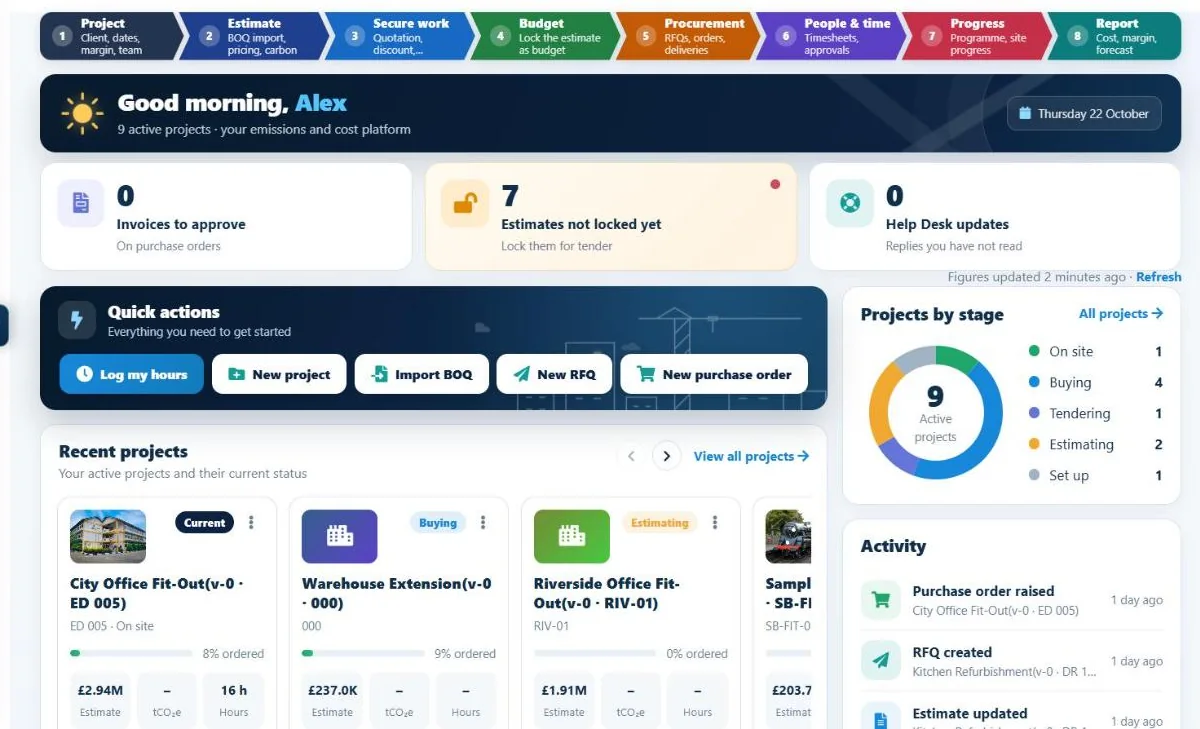
I-Cost brings your client's BOQ, estimate, supplier quotations, purchase orders, mobile site timesheets, and whole life carbon into one connected system for UK contractors, calculating live forecast margin from day one.
Frequently Asked Questions
What is margin leakage in construction?
Margin leakage is the gradual erosion of anticipated profit between tender award and practical completion, commonly caused by unrecovered variations, procurement price creep, unbudgeted preliminaries, and unapproved site daywork hours.
How does committed cost differ from incurred cost?
Incurred cost represents money for work already carried out or invoices received. Committed cost includes purchase orders placed and subcontracts let for which invoices have not yet arrived, giving early visibility of final expenditure.
Why do verbal site variations frequently lose money?
Under standard UK construction contracts such as JCT and NEC4, variations must be formally instructed in writing. Executing changes without written instructions or agreed rates makes retrospective recovery during final account negotiations extremely difficult.