 I-COST
Moving from Retrospective Accounting to Prospective Cost Control
Too many UK contracting businesses manage project finances by looking in the rear-view mirror. When a contractor relies on their standard accounting software (such as Xero, Sage, or QuickBooks) to determine project health, they only see invoices that have been received, processed, and entered into the purchase ledger.
In the construction sector, there is a substantial time lag—often six to eight weeks—between a site agent ordering materials, the supplier delivering them, the merchant issuing a month-end statement, and the finance team entering the invoice. By the time an accounting report flags that timber spend has exceeded budget by £15,000, that money is long gone.
Effective construction cost control requires monitoring The Four Cost States in real time.
The Four Cost States Every Contractor Must Understand
- Budgeted Cost: The original baseline estimate established at tender award, broken down into trade packages and cost types (Labour, Plant, Materials, Subcontract, Preliminaries).
- Committed Cost: The total value of all Purchase Orders issued and formal subcontracts let. This is money the business has legally pledged to spend, regardless of whether invoices have arrived.
- Incurred / Accrued Cost: The value of materials physically delivered to site and subcontractor work performed to date for which invoices have not yet been certified.
- Actual Cost: Invoices approved, processed, and paid through the finance ledger.
Worked Example: Weekly Cost Commitment Tracker
Here is an illustrative view of how committed cost tracking prevents budget overruns on a £450,000 groundwork and civil package:
| Cost Heading | Approved Baseline Budget | Committed Orders Placed | Actual Invoices Paid | Uncommitted Balance Remaining | Budget Status |
|---|---|---|---|---|---|
| Ready-Mix Concrete | £115,000 | £108,500 | £62,000 | £6,500 | On Track |
| Reinforcement Mesh & Bar | £48,000 | £51,200 | £24,000 | -£3,200 | Over Budget Warning |
| Excavator & Dumper Plant Hire | £65,000 | £68,400 | £41,500 | -£3,400 | Over Budget Warning |
| Direct Groundwork Labour | £140,000 | £92,000 | £78,000 | £48,000 | On Track (65% expended) |
| Drainage Pipes & Manholes | £52,000 | £46,800 | £18,000 | £5,200 | On Track |
| Site Preliminaries & Welfare | £30,000 | £28,500 | £15,000 | £1,500 | Tight Margin |
| Total Groundwork Package | £450,000 | £395,400 | £238,500 | £54,600 | Net Positive Buffer |
Notice the critical distinction: the accounting ledger shows only £238,500 paid, which might lull a director into believing the project is well under budget. In truth, commitments already stand at £395,400, and rebar steel and plant hire have already broken their package budgets. By identifying this early, the commercial team can adjust supplier allocations or challenge excessive plant retention before further orders are placed.
Key Takeaways
- Protect Margin from Day One: Margin leakage occurs incrementally; establish committed cost controls before placing orders.
- Enforce Written Protocols: Verbal site requests carry 100% contractor risk. Require written confirmations of verbal instructions (CAIs) immediately.
- Bridge the Estimating-Buying Gap: Ensure the tender estimate baseline directly governs purchase order authorization and live project tracking.
Explore how I-Cost supports construction commercial management
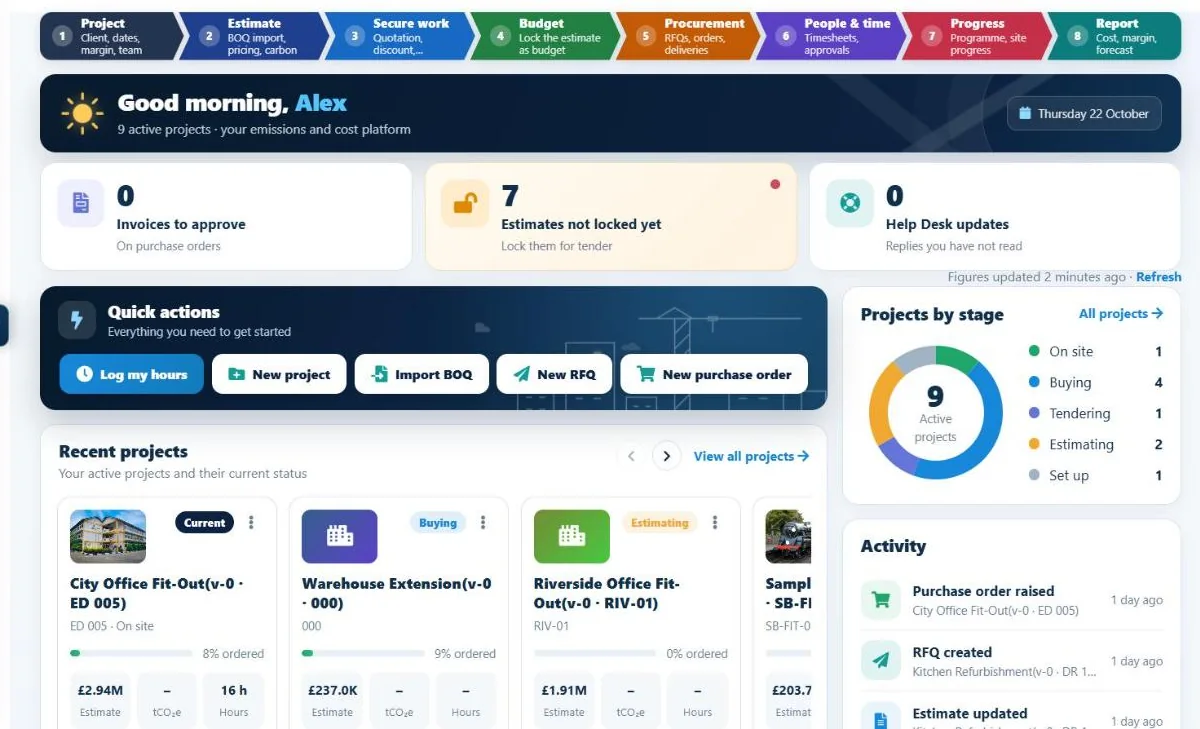
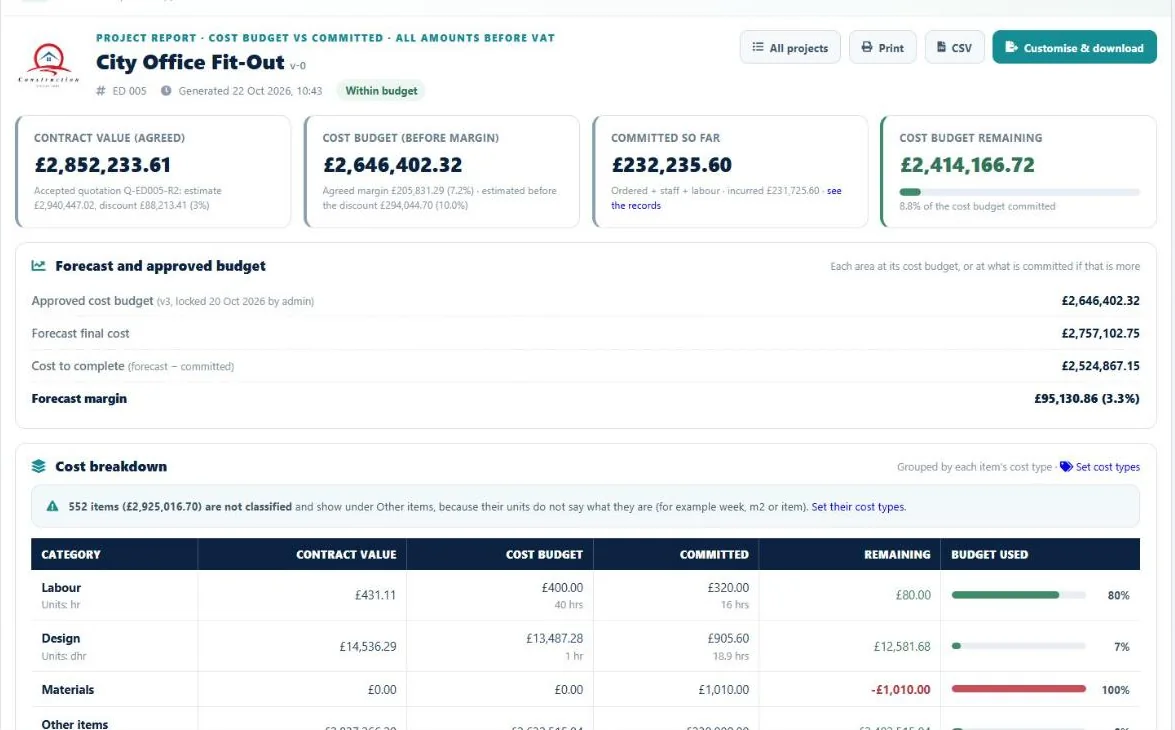
I-Cost brings your client's BOQ, estimate, supplier quotations, purchase orders, mobile site timesheets, and whole life carbon into one connected system for UK contractors, calculating live forecast margin from day one.
Frequently Asked Questions
What are the four essential cost states in construction?
The four states are: 1. Budgeted Cost (the baseline estimate), 2. Committed Cost (orders and contracts placed), 3. Incurred/Accrued Cost (physical work done and goods delivered), and 4. Actual Cost (invoices certified and paid).
Why is relying solely on accounting ledger costs dangerous?
Accounting ledgers record costs retrospectively when invoices are processed, typically 30 to 60 days after orders are placed on site. By contrast, tracking committed costs provides instant foresight of budget overruns before money is spent.
How often should cost-to-budget reviews occur?
On active construction projects, cost commitments and labour hours should be reviewed weekly, with formal Cost Value Reconciliations (CVRs) conducted on a monthly cycle.