 I-COST

The Single Largest Variable in Construction Profitability
For most specialist trade contractors in the UK—dryliners, bricklayers, joiners, mechanical and electrical installers, and groundworkers—labour represents between 35% and 55% of the total tender price, and over 80% of project risk. Material prices can be locked via fixed-price purchase orders, but labour productivity is dynamic, weather-dependent, and heavily influenced by site logistics.
When labour output drops by just 10%, projected company profit can be entirely eliminated. Improving site productivity is not about demanding trades work harder; it is about eliminating the systemic friction and idle time that prevents skilled operatives from completing their work.
The Main Drivers of Lost Labour Productivity
- Material Unavailability & Double Handling: Skilled trades waiting for materials to arrive or having to move heavy plasterboard, timber, or pipework across multiple floors due to poor logistics planning.
- Workface Clash & Out-of-Sequence Working: Trade gangs arriving at a work area only to find the previous contractor (e.g., M&E first-fix or screeding) has not completed their package.
- Unclear Design Details: Operatives stopping work to seek clarification on incomplete architectural or engineering drawings.
- Paper-Based Timesheet Fraud and Inaccuracy: Friday-afternoon paper timesheets where hours are guessed and non-productive waiting time is obscured under general trade codes.
Measuring and Benchmarking Trade Gang Output
To improve productivity, contractors must establish clear labour constants and benchmark actual site output against tender assumptions:
| Trade Operation | Standard UK Labour Constant | Tendered Output Target | Observed Friction Output (Poor Logistics) | Cost Variance Impact |
|---|---|---|---|---|
| Bricklaying (Facing Work) | 0.95 hrs / m² | 400 to 500 bricks / day (Bricklayer + Labourer) | 280 bricks / day (Waiting for mortar / scaffolding) | +35% labour cost per m² |
| Drylining (Stud & Single Board) | 0.28 hrs / m² | 35 m² / day per operative | 22 m² / day (Material hoisting bottlenecks) | +40% labour cost per m² |
| Floor Screeding (Sand/Cement) | 0.18 hrs / m² | 70 m² / day per operative | 45 m² / day (Delayed substrate handover) | +36% labour cost per m² |
| Electrical Conduit & Cable Tray | 0.65 hrs / metre | 12 linear metres / day | 8 linear metres / day (Clashing with HVAC ductwork) | +33% labour cost per metre |
Four Practical Steps to Improve Site Productivity
1. Switch to Daily Mobile Timesheet Logging
Replace paper sheets with smartphone timesheets. When trades record their hours daily against specific project cost codes (e.g., "Plot 14 - First Fix Electrics" vs "Daywork Instruction #04"), site supervisors verify hours while details are fresh.
2. Conduct Daily 10-Minute Stand-Up Briefings
Every morning, trade foremen should hold brief meetings with gang leaders: confirm the exact work faces to be completed, check all required materials and fixings are present, and identify potential clashes before operatives deploy.
3. Enforce Just-In-Time Staged Deliveries
Coordinate deliveries so materials are dropped directly at the work location rather than dumped in a central compound where trades waste hours double-handling pallets.
4. Separate Base Contract Work from Dayworks
Never allow operatives to mix base contract tasks and client variations on the same time entry. Segregated recording ensures legitimate variation hours can be claimed from the client rather than absorbed as contractor overhead.
Key Takeaways
- Protect Margin from Day One: Margin leakage occurs incrementally; establish committed cost controls before placing orders.
- Enforce Written Protocols: Verbal site requests carry 100% contractor risk. Require written confirmations of verbal instructions (CAIs) immediately.
- Bridge the Estimating-Buying Gap: Ensure the tender estimate baseline directly governs purchase order authorization and live project tracking.
Explore how I-Cost supports construction commercial management
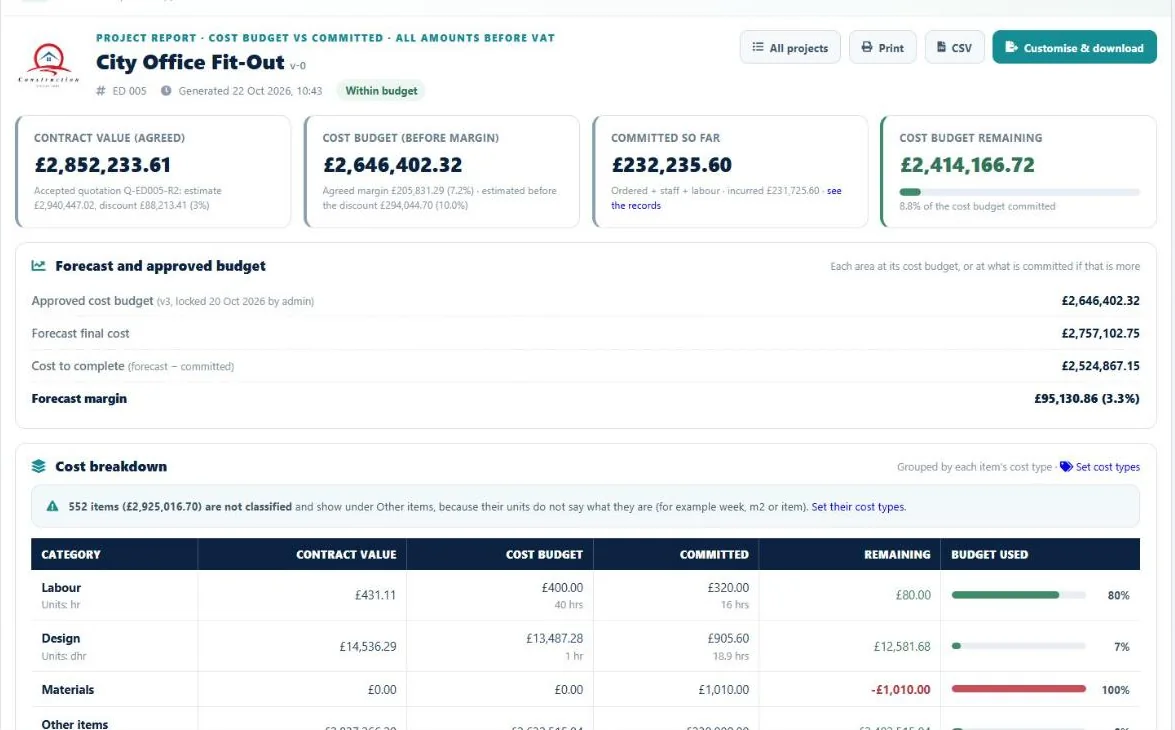
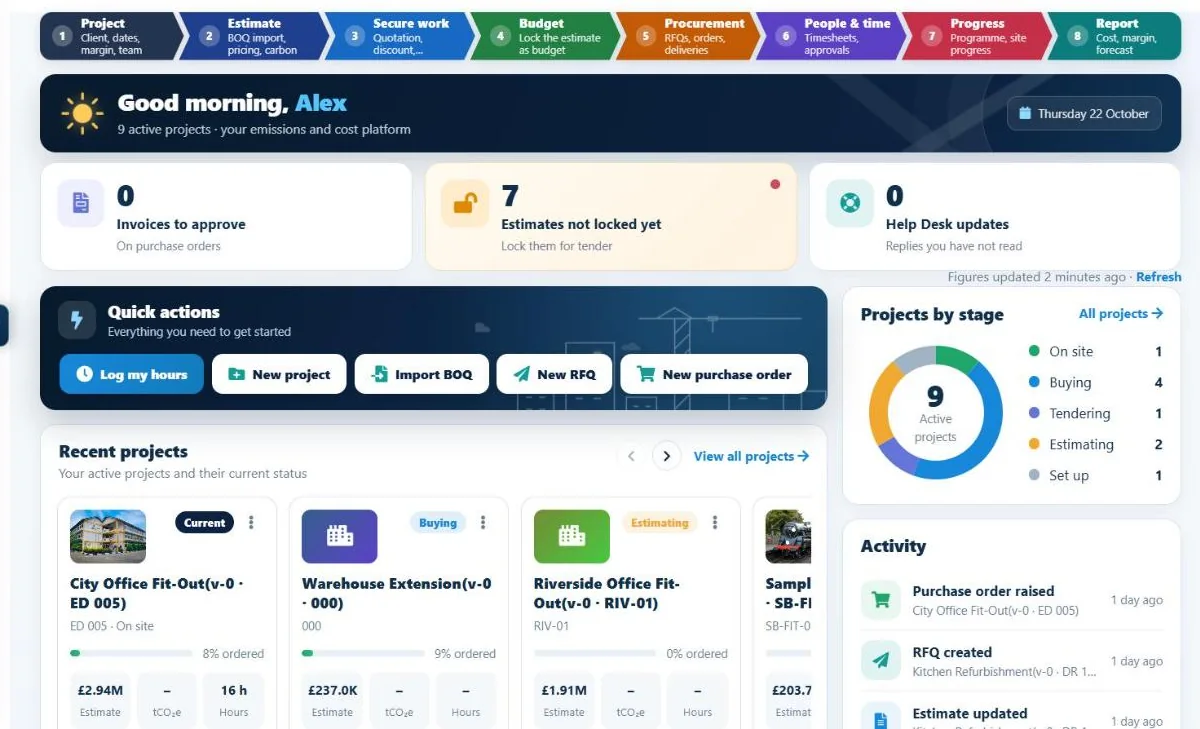
I-Cost brings your client's BOQ, estimate, supplier quotations, purchase orders, mobile site timesheets, and whole life carbon into one connected system for UK contractors, calculating live forecast margin from day one.
Frequently Asked Questions
What proportion of site labour time is typically non-productive?
Industry studies by organisations such as the CITB and BRE indicate that direct craft trades spend between 30% and 45% of their working day on non-productive activities, including waiting for materials, searching for drawings, transit across site, and clearing work faces.
How does digital mobile timesheet logging improve productivity?
Mobile timesheets eliminate paper timecards, record exact hours per cost code daily, prevent retrospective hour inflation, and allow site managers to identify productivity dips immediately rather than at month-end.
What is the difference between direct PAYE labour and CIS subcontract labour?
PAYE labour involves direct employment with statutory holiday, pension, and employer NIC obligations. The Construction Industry Scheme (CIS) applies to self-employed trade subcontractors, where contractors deduct tax at source (typically 20% for verified subcontractors).