 I-COST

Why Carbon Is Now a Commercial Tender Requirement
Until recently, carbon reporting in UK construction was regarded as an elective corporate responsibility exercise confined to institutional investors and Tier-1 joint ventures. Today, whole life carbon assessment is rapidly becoming an explicit tender requirement across public procurement (driven by Procurement Policy Note PPN 06/21), local planning conditions (such as the Greater London Authority London Plan), and private commercial clients with net-zero mandates.
Contractors who can quantify both the financial cost (£) and the embodied carbon (kgCO&sub2;e) of their bill of quantities items possess a significant competitive advantage over competitors who treat sustainability as an afterthought.
The BS EN 15978 / RICS Life-Cycle Framework
Embodied carbon calculations follow the European standard BS EN 15978 and the RICS Whole Life Carbon Assessment (WLCA) 2nd Edition standard, categorised into modular life-cycle stages:
- Upfront Carbon (Stages A1–A5):
- A1–A3 (Product Stage): Raw material extraction, transport to factory, and product manufacturing ("cradle-to-gate").
- A4 (Transport to Site): Logistics emissions from manufacturing plant to project site.
- A5 (Construction Installation): Site plant fuel, temporary works, electricity consumption, and material waste disposal.
- In-Use Carbon (Stages B1–B7): Maintenance, repair, replacement, and operational energy/water use.
- End-of-Life Carbon (Stages C1–C4): Deconstruction, demolition, transport to disposal, and waste processing.
- Module D (Benefits Beyond Boundary): Potential reuse, recovery, and recycling credits offsetting future extraction.
Calculating Embodied Carbon: A Practical Worked Example
Calculating embodied carbon utilizes a straightforward formula: Quantity of Material × Carbon Emission Factor = Total kgCO&sub2;e.
Carbon factors are sourced from verified Environmental Product Declarations (EPDs) or established industry benchmarks like the Inventory of Carbon and Energy (ICE Database) maintained by the University of Bath and Circular Ecology.
| Estimate Item Description | BOQ Quantity | Embodied Carbon Factor (ICE / EPD) | Total Upfront Carbon (kgCO&sub2;e) | Low-Carbon Alternative Comparison |
|---|---|---|---|---|
| Standard Portland Cement Concrete C30/37 | 120 m³ (approx. 288 tonnes) | 295 kgCO&sub2;e / tonne (A1-A3) | 84,960 kgCO&sub2;e | 50% GGBS cement replacement reduces factor to 160 kgCO&sub2;e/t (Saving: 38,880 kgCO&sub2;e) |
| Structural Steel Sections (Standard UK) | 18.5 tonnes | 1,740 kgCO&sub2;e / tonne (A1-A3) | 32,190 kgCO&sub2;e | Electric Arc Furnace (EAF) 100% recycled steel: 820 kgCO&sub2;e/t (Saving: 17,020 kgCO&sub2;e) |
| Standard Plasterboard (12.5mm) | 1,400 m² (approx. 12.6 tonnes) | 1.92 kgCO&sub2;e / m² (A1-A3) | 2,688 kgCO&sub2;e | Bio-composite plasterboard with recycled gypsum (Saving: 620 kgCO&sub2;e) |
| C24 Kiln-Dried Structural Softwood | 15 m³ (approx. 7.5 tonnes) | 310 kgCO&sub2;e / m³ (A1-A3 fossil) | 4,650 kgCO&sub2;e | FSC certified timber sequestering biogenic carbon during growth phase |
| Total Package Embodied Carbon | - | - | 124,488 kgCO&sub2;e (124.5 tCO&sub2;e) | Potential package reduction: 56.5 tCO&sub2;e (45.4%) |
How Contractors Can Win Work by Linking Cost and Carbon
Traditionally, carbon analysis required hiring external sustainability consultants weeks after tender submission. Modern contracting software allows commercial estimators to apply both a financial rate (£) and a carbon factor (kgCO&sub2;e) to the exact same BOQ line items.
When presenting your tender proposal, showing the client the direct cost and carbon trade-offs of specification alternatives positions your business as a forward-thinking, technically capable commercial partner.
Key Takeaways
- Protect Margin from Day One: Margin leakage occurs incrementally; establish committed cost controls before placing orders.
- Enforce Written Protocols: Verbal site requests carry 100% contractor risk. Require written confirmations of verbal instructions (CAIs) immediately.
- Bridge the Estimating-Buying Gap: Ensure the tender estimate baseline directly governs purchase order authorization and live project tracking.
Explore how I-Cost supports construction commercial management
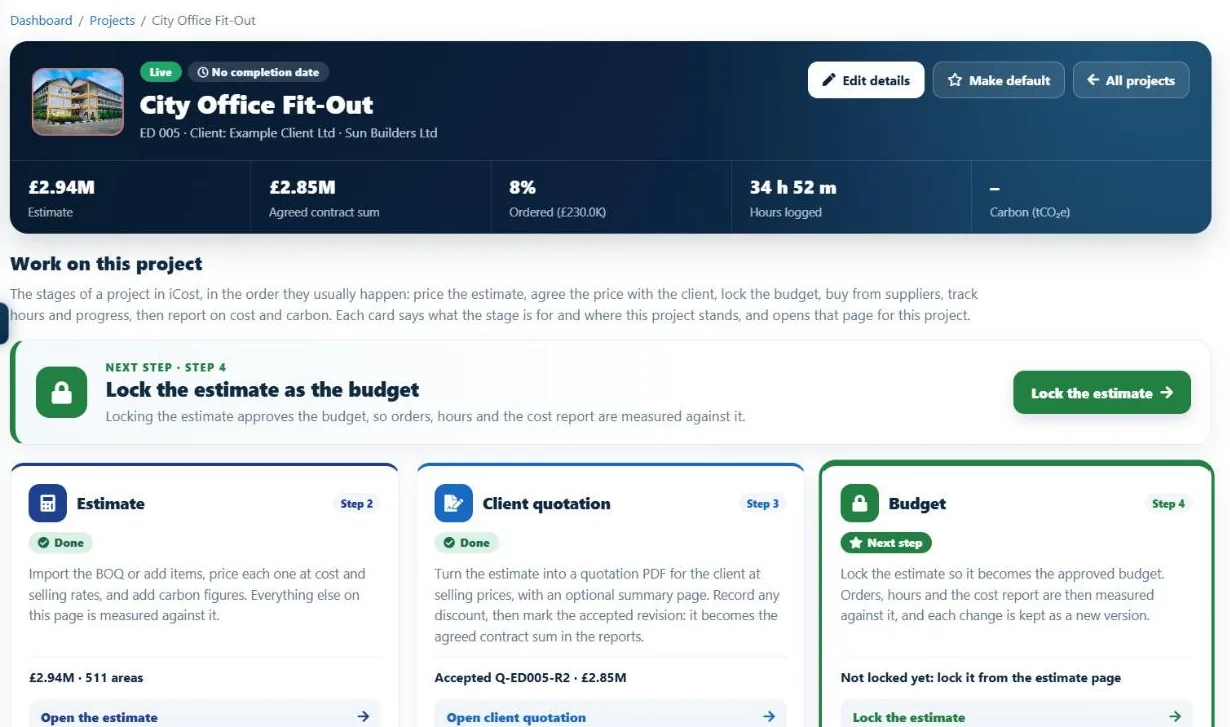
I-Cost brings your client's BOQ, estimate, supplier quotations, purchase orders, mobile site timesheets, and whole life carbon into one connected system for UK contractors, calculating live forecast margin from day one.
Frequently Asked Questions
What is the difference between embodied carbon and operational carbon?
Operational carbon is the greenhouse gas emissions generated by a building during its occupied life through heating, cooling, lighting, and power. Embodied carbon represents emissions associated with extracting raw materials, manufacturing products, transporting them to site, construction installation, maintenance, and end-of-life disposal.
What are life-cycle stages A1 to A5 under BS EN 15978?
Stages A1–A3 represent the 'cradle-to-gate' product stage (raw material extraction, transport to factory, manufacturing). Stage A4 covers transport from factory to the construction site. Stage A5 covers on-site installation, including construction waste and energy consumed by site plant.
What is the RICS Whole Life Carbon Assessment (WLCA) standard?
The RICS Whole Life Carbon Assessment for the Built Environment (2nd edition) provides a mandatory methodology for RICS members to calculate whole life carbon across building and infrastructure projects, becoming the benchmark standard for UK public and commercial tenders.