 I-COST

What Is a Bill of Quantities (BOQ)?
A Bill of Quantities (BOQ) is an itemised tender document prepared by the employer's quantity surveyor that lists every component of work required to complete a construction project, measured in standard units (m², m³, tonnes, items, or metres linear). By presenting a comprehensive schedule of quantities, tenderers price the exact same scope, enabling the client to evaluate competitive tenders on an authentic like-for-like basis.
In UK building works, bills of quantities are primarily prepared in accordance with the RICS New Rules of Measurement (NRM2: Detailed measurement for building works), which replaced the historic SMM7 standard. For civil engineering projects, the Civil Engineering Standard Method of Measurement (CESMM4) is widely used.
The Anatomy of an NRM2 Bill of Quantities
A standard NRM2 bill of quantities is structured into distinct volumes or sections:
- Part 1: Preliminaries (NRM2 Section 1 & 2): Covers general site conditions, project particulars, employer requirements, contractual stipulations, and contractor management costs (insurances, welfare, security, scaffolding, craneage, waste management).
- Part 2: Work Sections (NRM2 Sections 3 to 41): The physical works broken down by trade and element—groundwork, concrete, masonry, structural steel, cladding, MEP services, internal finishes, and external works.
- Part 3: Provisional and Prime Cost (PC) Sums: Allowances for work that cannot be entirely specified at tender stage.
- Defined Provisional Sums: Scope and location are sufficiently understood; contractor must include programme and preliminary allowances.
- Undefined Provisional Sums: Scope is not defined; contractor prices preliminaries later when work is instructed.
- Part 4: Daywork Schedules: Agreed hourly rates and percentage additions for labour, plant, and materials to value unanticipated works that cannot be priced using measured rates.
How to Build Up a Robust Unit Rate
Pricing a BOQ item is not an exercise in guesswork or copying historic rates from last year's files. Every rate is a synthetic build-up combining four essential elements: Labour + Materials + Plant + Subcontract / Specialist Input.
Worked Example: Cavity Brickwork Wall per m² (NRM2 Group 14)
Consider an item for "Facing brickwork in stretcher bond, 102.5mm thick, mortar 1:1:6, bed joint reinforcement every third course":
| Component | Resource Quantity per m² | Base Cost Rate | Total Net Cost per m² |
|---|---|---|---|
| Facing Bricks (65mm) | 60 bricks/m² + 5% waste allowance (63 bricks) | £720.00 / 1,000 bricks | £45.36 |
| Mortar (Sand/Cement/Lime) | 0.025 m³/m² + 10% waste (0.0275 m³) | £130.00 / m³ | £3.58 |
| Stainless Steel Wall Ties | 2.5 ties/m² | £0.42 / tie | £1.05 |
| Bed Joint Reinforcement | 0.33 linear metres / m² | £1.80 / linear metre | £0.59 |
| Bricklayer Labour Constant | 0.95 hours / m² | £32.00 / hour all-in labour rate | £30.40 |
| Labourer Support Constant | 0.45 hours / m² | £22.50 / hour all-in labour rate | £10.13 |
| Sundry Access & Mortar Mixer | Allowance per m² | Calculated plant allocation | £1.85 |
| Net Cost Rate (Labour + Plant + Materials) | - | - | £92.96 / m² |
| Overheads (10% on Net Cost) | - | - | £9.30 |
| Profit Margin (12% on Selling Price) | - | Target gross margin | £13.94 |
| Final BOQ Selling Rate to Submit | - | - | £116.20 / m² |
Common Pitfalls When Pricing UK BOQs
- Retyping Client BOQs: Manually typing hundreds of line items into spreadsheets leads to omitted rows, transcription typos, and formula errors that cost contractors thousands.
- Failing to Spot Measurement Conventions: Assuming items include accessories that NRM2 mandates must be measured separately (e.g., cavity trays, damp proof courses, movement joints).
- Neglecting Preliminaries Links: Pricing work items without evaluating the overall construction programme and site constraints detailed in the preliminaries.
- Ignoring Quote Validity Windows: Pricing supplier rates that expire in 30 days when the project construction start date is 6 months away.
Key Takeaways
- Protect Margin from Day One: Margin leakage occurs incrementally; establish committed cost controls before placing orders.
- Enforce Written Protocols: Verbal site requests carry 100% contractor risk. Require written confirmations of verbal instructions (CAIs) immediately.
- Bridge the Estimating-Buying Gap: Ensure the tender estimate baseline directly governs purchase order authorization and live project tracking.
Explore how I-Cost supports construction commercial management
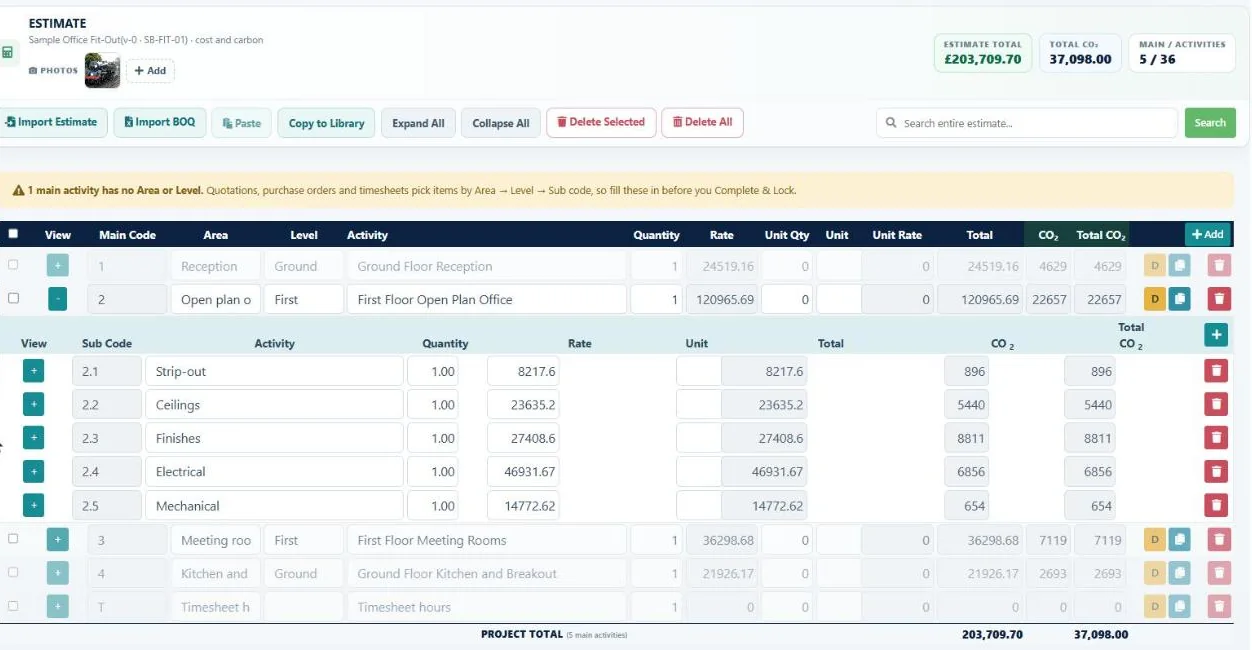
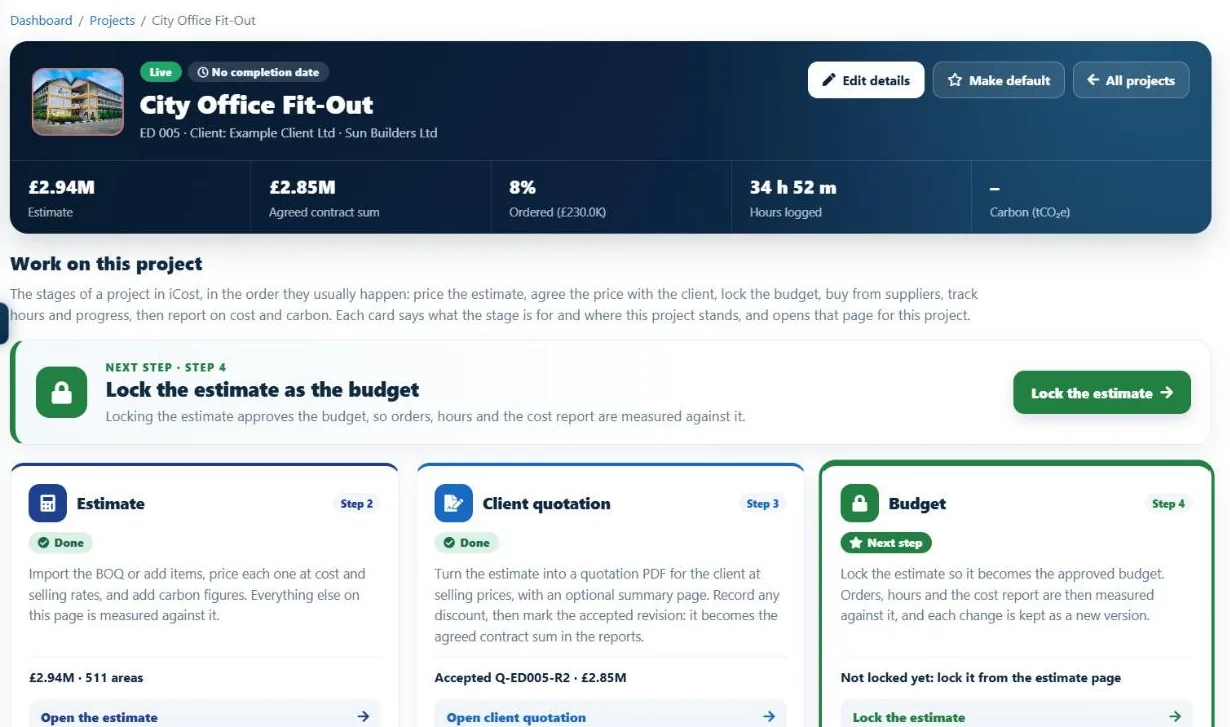
I-Cost brings your client's BOQ, estimate, supplier quotations, purchase orders, mobile site timesheets, and whole life carbon into one connected system for UK contractors, calculating live forecast margin from day one.
Frequently Asked Questions
What is the primary standard for BOQ measurement in the UK?
In the UK building sector, the RICS New Rules of Measurement 2 (NRM2: Detailed measurement for building works) is the industry standard for preparing bills of quantities, providing definitive measurement rules and item descriptions.
What is the difference between defined and undefined provisional sums?
A defined provisional sum is one where the nature, quantity, and programme implications of the work are sufficiently described for the contractor to plan and price preliminaries. An undefined provisional sum lacks such detail, meaning programming, preliminaries, and sequencing must be adjusted when the instruction is finally issued.
Can contractors submit qualifications with a priced BOQ?
Yes, but care must be taken. While tender qualifications allow contractors to clarify assumptions, material tolerances, and exclusions, non-compliant bids under strict public procurement or JCT rules risk disqualification unless alternative bids are permitted.