 I-COST

When winning the work leaves less room for profit
A subcontractor can win a tender at a sensible margin and still lose that margin before the first installation. The supplier quotation expires, the start date moves and the labour allowance assumes uninterrupted access that never materialises. The selling price stays fixed while the cost of delivering the same scope changes.
For UK construction costs in 2026, the useful question is therefore specific: which parts of this package are exposed between tender and purchase? A national index provides context, but it cannot replace a current quotation for the specification, location and delivery date you actually need.
What the published evidence says
The ONS August 2026 construction bulletin, released on 15 October 2026, estimates that Great Britain construction output fell by 1.0% over the three months to August. That is an output-volume measure, not a materials-price index or a measure of subcontractor profitability.
The BCIS construction forecast published on 8 October 2026, based on information available to 8 September, forecasts building costs rising by 14% over the five years to the third quarter of 2031. BCIS expects costs to rise faster than tender prices in the near term. These are forecasts, not a realised 2026 increase or a rate to add automatically to every trade package.
Together, these releases support a practical concern: subdued demand can make price recovery difficult even when inputs become more expensive. They do not establish that every contractor is losing margin. Your own buying records remain the strongest evidence of exposure on a particular job.
Three pressures to separate in a rate build-up
Materials and supplier terms
Check product specification, quantities, waste, delivery charges and quotation validity. A lower unit price can become a higher delivered cost once minimum orders, unloading or storage are included. Ask whether phased deliveries preserve the quoted rate and what happens if the programme changes.
Labour and productive time
A labour rate is only half the calculation. Hours per unit depend on access, sequencing, preparation and supervision. Reusing last year's output allowance on an occupied refurbishment can understate cost even if the hourly rate has barely changed. Keep the wage assumption separate from the productivity assumption.
Time between tender and commitment
An estimate records assumptions at a point in time. A purchase order records a later commitment. Identify the gap explicitly: what is covered by a valid fixed quotation, what remains provisional and who must approve a refresh before ordering?
Worked example: a finishing subcontract
This illustration excludes VAT and is not a market-rate benchmark. A £200,000 fixed-price package was tendered at £170,000 cost, leaving £30,000 contribution before business overheads and tax.
| Cost element | Tender | Revised |
|---|---|---|
| Materials | £70,000 | £75,600 |
| Labour | £80,000 | £84,000 |
| Plant and site overheads | £20,000 | £22,000 |
| Total cost | £170,000 | £181,600 |
Contribution falls to £18,400. The margin on sales falls from 15% to 9.2%, although delivery cost has risen by only £11,600. The assumptions are an 8% materials increase, 5% labour increase and £2,000 extra site cost. They are illustrative sensitivities, not published inflation figures.
Turn the forecast into buying decisions
- Refresh high-value and long-lead quotations before award acceptance and before order placement.
- Compare suppliers on the same scope, quantities, delivery dates and exclusions. Record the cost of filling any gaps.
- Set procurement dates against the programme, considering storage, insurance and working capital before buying early.
- Retain the approved tender budget. Record changes separately so an overrun cannot disappear into a rewritten baseline.
- Review outstanding orders, labour hours and remaining work weekly; investigate differences while options remain open.
Use the supplier quotation comparison guide for like-for-like buying and the committed cost guide to recognise exposure before invoices arrive.
Practical takeaway
Start with the five largest unplaced purchases on a live job. Record each quotation's expiry, required delivery, budget allowance and current delivered price. Assign an owner to every difference. That small review is more actionable than applying a single national inflation percentage to the entire estimate.
Keep the tender and buying budget connected
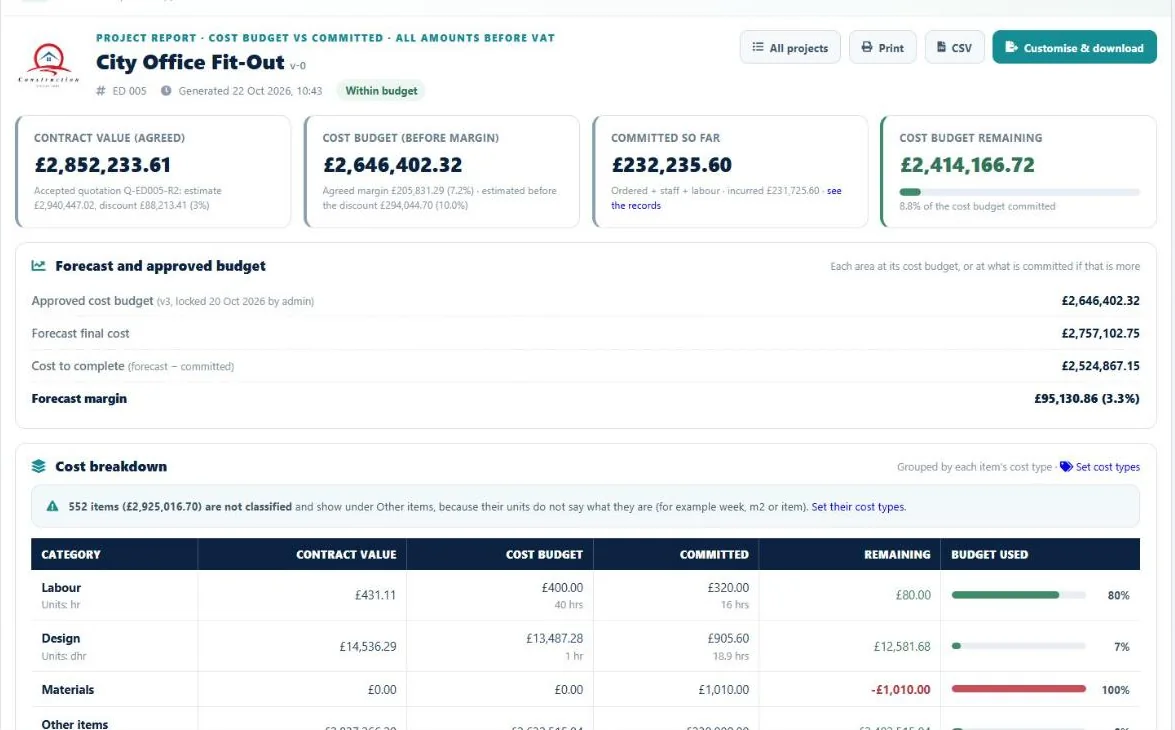
Explore how I-Cost links estimates, supplier quotations, purchase orders and project cost reports. Use current quotations and review the underlying assumptions before committing expenditure.
Frequently asked questions
Are UK construction costs rising by the same amount for every trade?
No. National measures aggregate different work. Check current supplier prices, location, specifications and labour productivity for each package.
Should I add the BCIS five-year forecast to a 2026 tender?
No. A multi-year forecast is contextual evidence. Price the actual procurement period and contractual risk using current quotations and explicit assumptions.
What is the difference between margin and markup?
Margin divides contribution by selling price. Markup divides contribution by cost. In the example, £30,000 on £200,000 sales is a 15% margin.