 I-COST
Price Discovery vs Financial Commitment
In construction commercial management, confusing price discovery with contractual commitment is a frequent source of disputes. Site agents frequently telephone suppliers, ask for a price, and say "send it over on Monday", assuming they are simply following up an inquiry. In reality, they have verbally entered into a binding commitment without agreed terms, fixed delivery slots, or budget verification.
Maintaining a strict commercial boundary between a Request for Quotation (RFQ) and a formal Purchase Order (PO) is vital for contract protection and cash flow control.
Key Differences: RFQ vs Purchase Order
| Commercial Dimension | Request for Quotation (RFQ) | Purchase Order (PO) |
|---|---|---|
| Legal Status | Invitation to treat. Carries zero legal commitment to purchase. | Formal legal offer to buy goods or services under specified terms. |
| Financial Accounting | No financial impact. Does not affect company accounts or ledger. | Creates a committed cost against the project budget immediately. |
| Primary Purpose | Market pricing discovery, availability checking, and rate negotiation. | Contract award, delivery instruction, and payment commitment. |
| Governing Terms | Information gathering; usually incorporates no performance terms. | Contractor's standard purchasing terms and conditions attached. |
| Required Authorisation | Estimators, buyers, or quantity surveyors during bid preparation. | Designated signing authority (e.g., Commercial Director / Project Manager). |
The Three-Way Matching Protocol
A Purchase Order is not merely an email instruction; it is the cornerstone of construction cost control. It establishes the benchmark against which deliveries and invoices are verified:
- Purchase Order (PO): What we agreed to buy and at what rate.
- Goods Received Note (GRN): What physical quantity actually arrived on site and was signed for.
- Supplier Invoice: What the merchant is charging us for.
When an accounts department enforces Three-Way Matching, no invoice is cleared for payment unless the rates match the PO and the quantities match the signed GRN. This prevents supplier overbilling, duplicate invoicing, and payment for unsupplied materials.
Key Takeaways
- Protect Margin from Day One: Margin leakage occurs incrementally; establish committed cost controls before placing orders.
- Enforce Written Protocols: Verbal site requests carry 100% contractor risk. Require written confirmations of verbal instructions (CAIs) immediately.
- Bridge the Estimating-Buying Gap: Ensure the tender estimate baseline directly governs purchase order authorization and live project tracking.
Explore how I-Cost supports construction commercial management
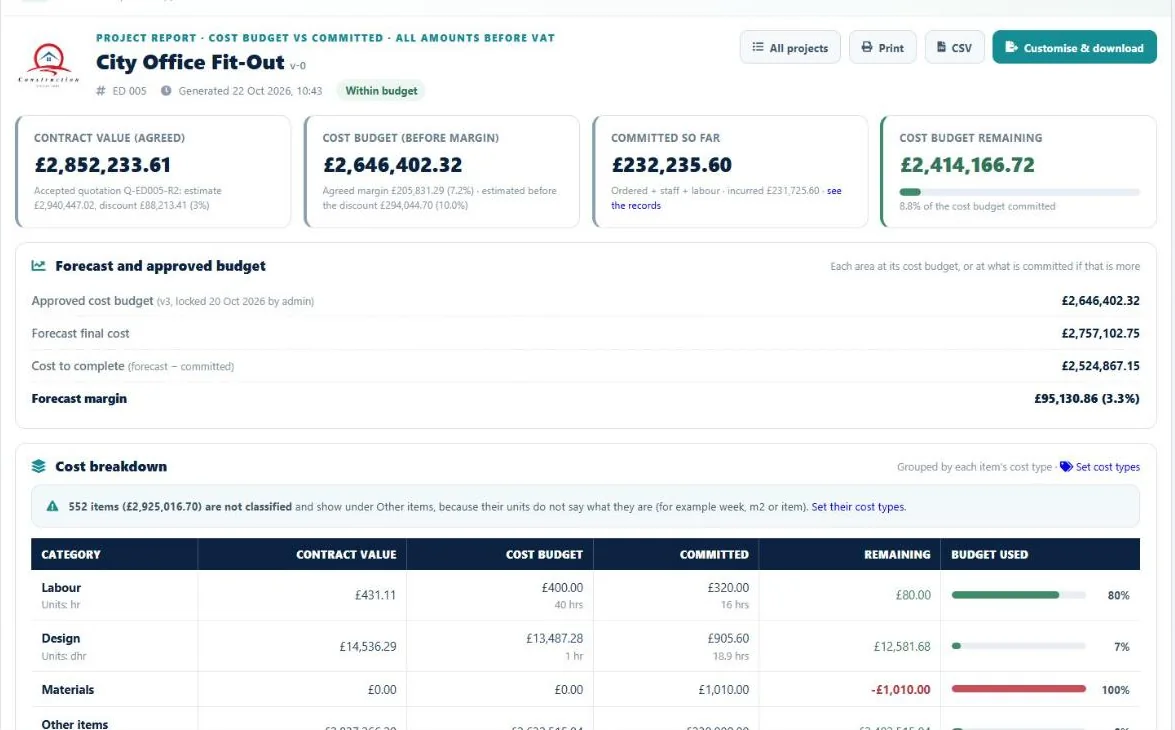
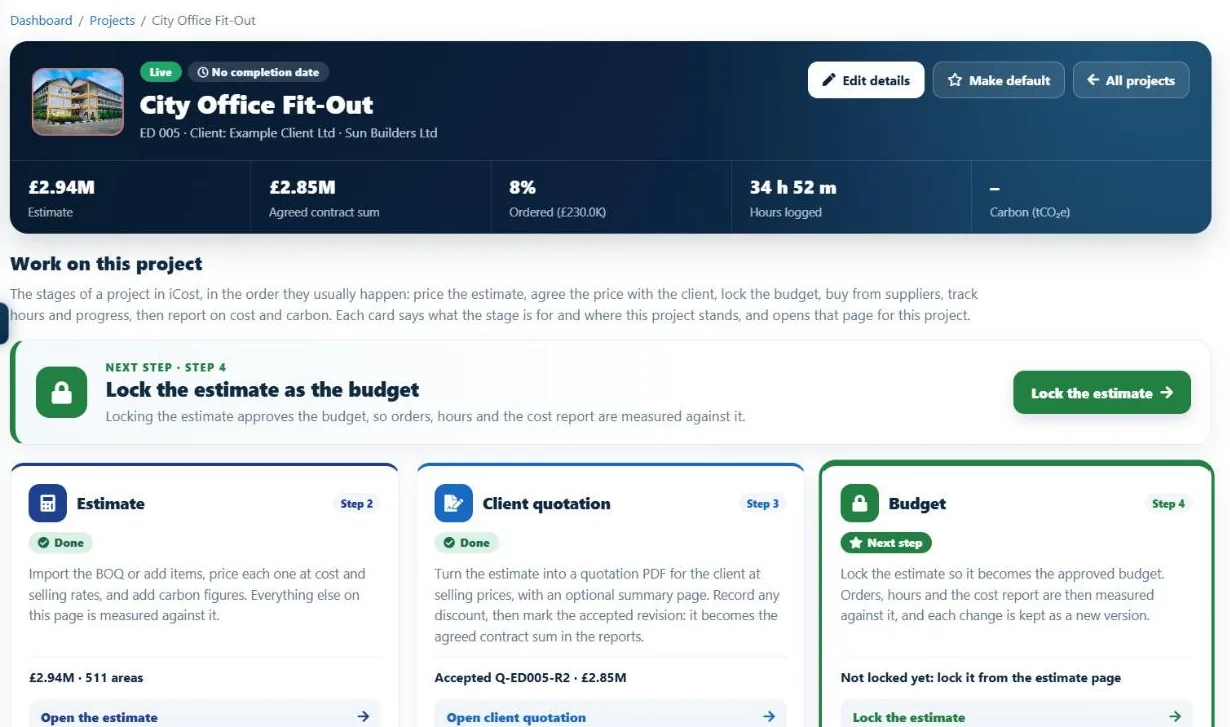
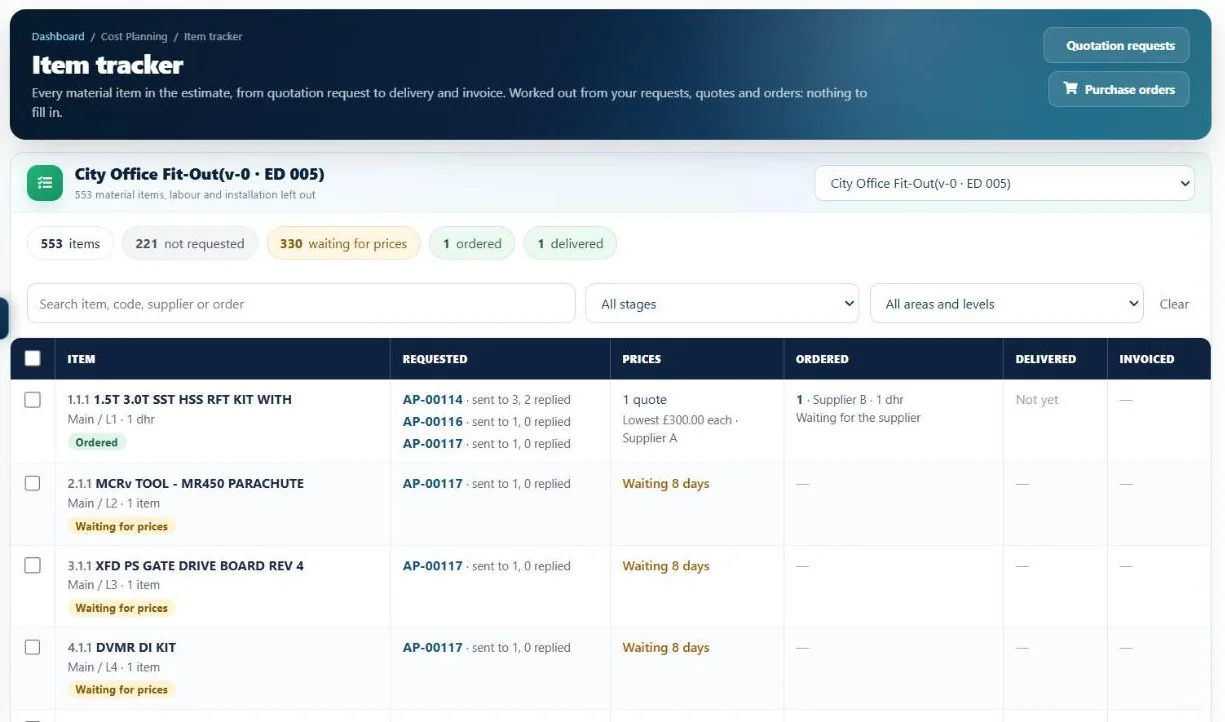
I-Cost brings your client's BOQ, estimate, supplier quotations, purchase orders, mobile site timesheets, and whole life carbon into one connected system for UK contractors, calculating live forecast margin from day one.
Frequently Asked Questions
Is an RFQ a legally binding document in the UK?
No. Under English contract law, a Request for Quotation (RFQ) is an 'invitation to treat'. It invites suppliers to submit an offer, creating no contractual obligation on either party to buy or sell.
When does a Purchase Order become a legally binding contract?
A Purchase Order (PO) constitutes a legal offer to purchase. When the supplier acknowledges the PO in writing, issues an order confirmation, or acts upon it by dispatching goods, a binding contract is formed.
What is the 'Battle of the Forms' in construction purchasing?
The Battle of the Forms refers to disputes over which party's standard terms and conditions govern a transaction. Under English law, the 'last shot' doctrine typically applies: the last party to send their terms before performance without objection wins.