 I-COST
The Construction Industry's Oldest Relationship: Estimators and Excel
Microsoft Excel is arguably the most successful software tool in commercial history. For over three decades, quantity surveyors, estimators, and trade contractors across the UK have relied on spreadsheets to calculate rate build-ups, format valuations, and submit tenders. It is familiar, accessible, and virtually free of incremental cost.
However, as tender turnaround times shorten, bills of quantities expand in complexity, and material prices fluctuate rapidly, the inherent limitations of spreadsheets create significant commercial exposure. For specialist subcontractors turning over £1m to £15m, relying on unlinked, single-user Excel files poses serious business risks.
Feature-by-Feature Comparison: Excel vs Dedicated Estimating Platforms
| Commercial Requirement | Microsoft Excel Spreadsheets | Modern Estimating Software (e.g. I-Cost) |
|---|---|---|
| Data Integrity & Formulas | Vulnerable to accidental cell overwrites, formula corruption, and broken VLOOKUP references without warning. | Protected computational core. Cost build-up formulas, markups, and margins are hard-coded and mathematically isolated. |
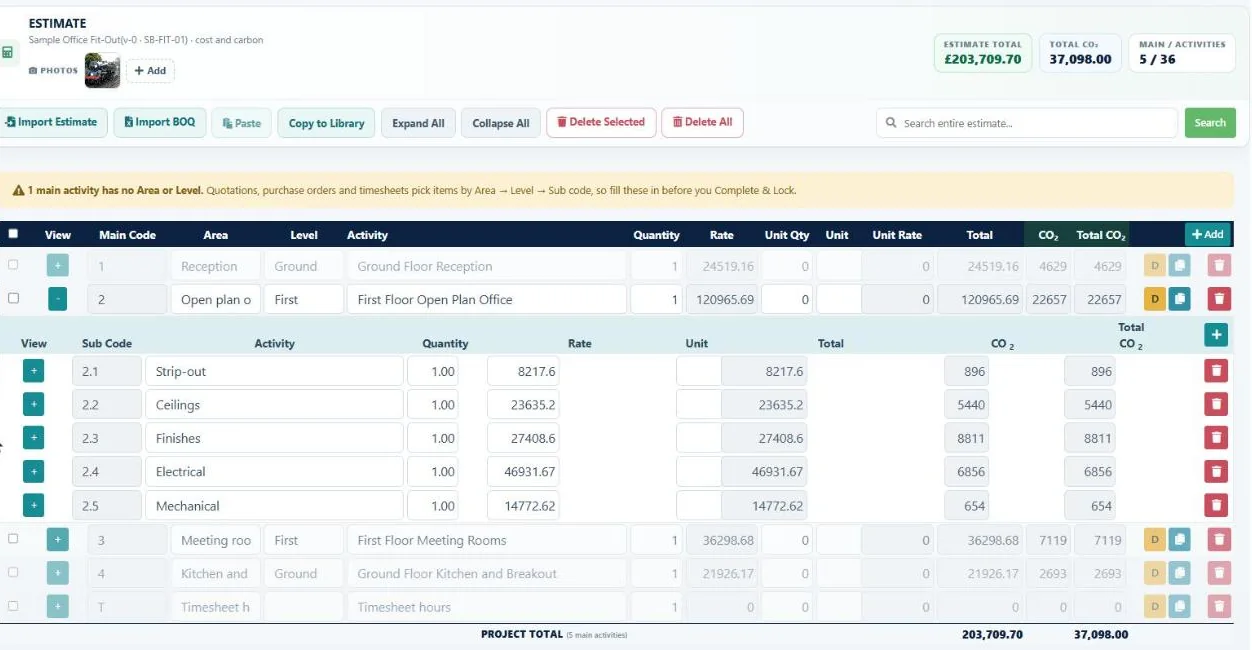
| BOQ Import Speed | Requires manual copy-pasting, cell reformatting, and column alignment for every tender. | Direct Excel/CSV upload. Automatic column mapping with live preview and sum check before import. |
| Material Price Freshness | Static data. Old rates remain in template worksheets unless manually updated by the estimator line by line. | Dynamic rate verification. Rates are automatically cross-checked against recent purchase orders and current supplier quotes. |
| Multi-User Collaboration | File locking conflicts; multiple versions (e.g., Tender_Final_v3_revB_JW.xlsx) circulating across emails. | Centralised cloud access. Multiple team members can price packages simultaneously with clear permission controls. |
| Margin vs Markup Calculation | Frequent human error; confusing cost markup with selling margin can cause immediate 4% to 6% profit loss. | Explicit mathematical separation between markup on cost and gross margin on tender selling price. |
| Audit Trail & Version History | Minimal accountability. Impossible to identify who changed an individual unit rate at 11:30 PM before tender deadline. | Full audit log detailing every rate change, user stamp, and timestamp for complete commercial transparency. |
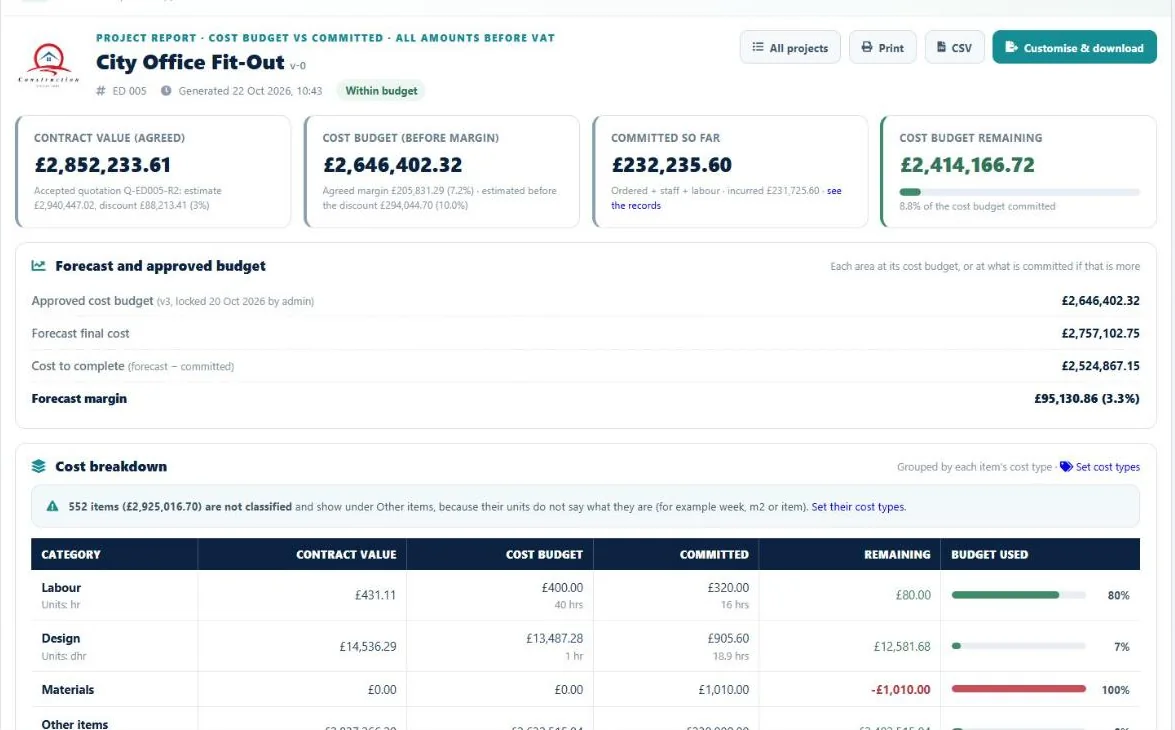
| Post-Award Transition | Estimating files sit detached on desktop folders. Buying team starts procurement from scratch. | The won estimate automatically becomes the live project cost budget, item tracker, and purchasing baseline. |
The True Financial Cost of a Spreadsheet Error
Consider an actual scenario observed on a £840,000 commercial roofing and cladding tender. The estimator built up rates across four sheets, using a summary tab with a standard =SUM(D12:D84) formula. When three additional insulation line items were inserted at row 85, the sum range did not automatically extend.
The contractor won the project, only to discover £38,400 of required high-density insulation materials was entirely missing from the submitted contract sum. The mistake wiped out 45% of the projected operating profit before site mobilisation had even begun.
A software investment of £35 to £70 per month represents less than 0.05% of the risk exposure of a single unnoticed formula defect on an average £500k subcontract package.
When Does Excel Still Make Sense?
Excel remains an outstanding scratchpad for quick rough-order-of-magnitude (ROM) sanity checks, bespoke financial modelling, or small domestic jobs under £20,000 where formal BOQs and contractual procurement controls are not applicable. For commercial tenders where contractors assume performance and price risk, modern estimating software provides security that spreadsheets cannot match.
Key Takeaways
- Protect Margin from Day One: Margin leakage occurs incrementally; establish committed cost controls before placing orders.
- Enforce Written Protocols: Verbal site requests carry 100% contractor risk. Require written confirmations of verbal instructions (CAIs) immediately.
- Bridge the Estimating-Buying Gap: Ensure the tender estimate baseline directly governs purchase order authorization and live project tracking.
Explore how I-Cost supports construction commercial management
I-Cost brings your client's BOQ, estimate, supplier quotations, purchase orders, mobile site timesheets, and whole life carbon into one connected system for UK contractors, calculating live forecast margin from day one.
Frequently Asked Questions
Why is Excel so widely used for estimating in construction?
Excel is universal, flexible, and already installed on almost every business PC with no extra software subscription. Estimators can tailor formulas and sheets freely to their personal preferences.
What is the biggest operational risk of using spreadsheets for tenders?
Undetected formula errors and broken cell references. Research by the European Spreadsheet Risks Interest Group (EuSpRIG) indicates over 88% of complex business spreadsheets contain formula errors, which in construction can result in significantly underpriced tenders.
How long does it take for a subcontractor to transition from Excel to estimating software?
For modern cloud-based estimating systems with BOQ import capabilities, typical onboarding takes between 2 to 5 days, compared to months for legacy desktop platforms.