 I-COST

A photo can start the conversation
A customer notices a damaged ceiling, takes two phone photographs and asks a contractor for a price. The contractor can see the visible damage, but not the ceiling's dimensions, the cause of the leak or whether the surrounding surface is sound. A useful quotation request needs to close those gaps.
Photo-based construction quotations can be a practical way to start small works enquiries. “Only photos” is usually too little information for a dependable fixed scope. The more useful workflow combines pictures with measurements, location, intended finish, access arrangements and clear assumptions.
This article describes an industry workflow, not an available I-Cost photo-only quotation service. The local website documents photos on estimates and estimate-based supplier requests, but does not verify a standalone customer-photo-to-supplier quotation feature.
Which jobs can photos help describe?
Painting and decoration
Room photographs show the layout and visible condition. Add room dimensions, ceiling height, approximate openings, the surfaces to be painted and the required finish. State whether the room will be cleared and whether preparation includes stripping paper, filling cracks or treating staining.
Plastering and local repairs
Wide shots help locate a defect and close-ups show its appearance. Supply the approximate repair area and explain whether the underlying cause has been investigated. A photograph cannot confirm the condition or suitability of the concealed substrate, so the contractor may need an inspection before committing to a method and price.
Small refurbishment works
Photos can help communicate a cupboard alteration, damaged joinery or a local floor repair. Add a simple marked-up sketch and identify adjacent items to protect. Work involving structure, fire performance, concealed services or uncertain hazardous materials needs competent assessment beyond an image-based enquiry.
What to send alongside the photographs
| Information | Useful detail |
|---|---|
| Location and use | Postcode, floor, property type and whether occupied. |
| Measured scope | Length, width, height and quantities, with units and a sketch. |
| Existing condition | Known leaks, previous repairs and available survey information. |
| Required result | Finish, colour, material specification and quality expectations. |
| Access and logistics | Parking, stairs, working hours, protection and waste arrangements. |
| Timing | Preferred dates, deadline and any dependency on another trade. |
| Commercial basis | Request a defined quotation or an indicative budget, and identify exclusions. |
Take a wide view, a mid-range view and a close-up of each location, then label the images to match the sketch. Use daylight where possible. Avoid sharing people, personal paperwork, access codes or other information that is unnecessary for the enquiry.
Do not climb, disturb suspect materials or remove electrical covers to improve a photograph. Ask the contractor what further information can be gathered safely. A missing image is a reason for clarification, not for an unqualified person to investigate a hazard.
A simple customer-to-supplier workflow
- Prepare: the customer supplies labelled pictures, measured quantities, location, access details and the desired result.
- Screen: the supplier reviews whether the work is within their competence and whether remote information is adequate.
- Clarify: questions and answers are recorded in writing; uncertain work is identified for inspection.
- Define: the supplier states scope, assumptions, exclusions, duration, price validity, tax treatment and any provisional items.
- Review: the customer compares like-for-like offers and requests missing information before acceptance.
- Confirm: the agreed scope and applicable terms are recorded, with a process for approving changes before extra work proceeds.
The order matters. Asking several suppliers to price an ambiguous photograph can produce several different scopes rather than a meaningful price comparison. The quotation comparison guide explains how to resolve those differences.
Worked example: repainting one room
Assume a room is 4 m by 3 m and 2.4 m high. Gross wall area is 2 × (4 + 3) × 2.4 = 33.6 m². If the measured openings total 4.0 m², the illustrative net wall area is 29.6 m²; the ceiling is another 12 m². Confirm the supplier's measurement and pricing basis rather than assuming these deductions apply.
The request should identify whether the price includes both walls and ceiling, the number of coats, preparation, materials, furniture protection, skirtings and waste. Two identical photographs could otherwise generate a wall-only quote and a full room redecoration quote that cannot be compared fairly.
If one supplier includes £120 for making good and another excludes preparation, ask for the same preparation scope before comparing totals. That £120 is an invented example of an allowance, not a suggested market price. No reliable painting rate can be derived from room area alone without specification and condition checks.
When a site visit or formal BOQ remains necessary
Request a site visit when dimensions are uncertain, access equipment may be needed, moisture or movement requires diagnosis, or concealed conditions materially affect the method. The supplier should explain whether the remote figure is indicative, provisional or a quotation for a clearly defined scope.
Larger refurbishment packages and work with several trades often need drawings, specifications and a formal bill of quantities. Photographs can supplement that information, but they cannot establish coordination details or concealed construction. Preserve the original request and clarifications so later changes can be distinguished from the accepted scope.
A remote enquiry also does not settle legal terms, consumer rights or approval requirements. The contract and applicable rules still matter. This guide does not attempt to define when an emailed price becomes binding; clarify the offer, acceptance and terms with appropriate advice where needed.
Practical takeaway
Use a one-page request with five headings: measured scope, required finish, known condition, access and timing. Attach labelled photographs and ask the supplier to state what must be checked on site. That gives both parties a useful starting point without pretending that a camera can reveal everything the work involves.
Compare quotations against an agreed scope
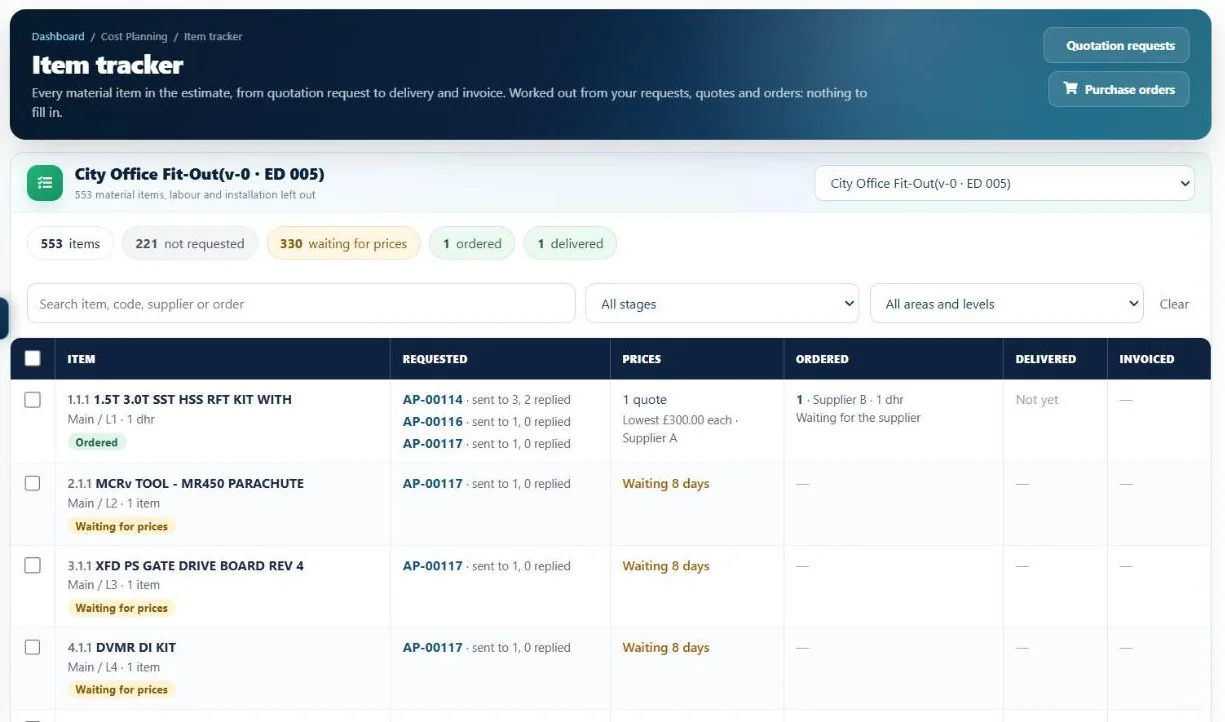
I-Cost’s existing platform page describes estimate-based quotation requests and supplier responses. Photos on estimates are documented, but a customer photo-only request-to-supplier workflow is not verified in this codebase.
Frequently asked questions
Can a builder give a fixed price from photographs alone?
Sometimes a tightly defined, low-uncertainty task can be priced remotely. Missing dimensions, concealed conditions or unclear access may require further information or a site visit.
How many photographs should I send?
Send enough labelled wide, mid-range and close-up views to explain each location. Clear coverage and supporting measurements matter more than a fixed number.
Are photo quotations an existing I-Cost feature?
A standalone photo-only quotation workflow is not verified in the local codebase. Existing site pages describe photos on estimates and estimate-based supplier quotation requests.
Can photos replace a BOQ for a larger project?
They can supplement drawings and measured scope, but they do not replace a coordinated specification or BOQ when the package needs those controls.